Coffee
No haggl.ai
33.3%$20.19 AOV
haggl.ai
50.0%$19.58 AOV
- Recommendation lift
- +50.0%
- AOV change
- -3.0%
Your sales agent learns what each team needs and offers the right plan, within your budget.
Your customers don’t need to know haggl.ai exists. When their personal agent lands on your site, it discovers your sales agent and starts a conversation about a better offer. No extra setup for the shopper.
 ChatGPT
 Instinct
 Muse · Meta
Our conviction: personal agents will become an everyday way to compare options and buy. Give your business a voice in that decision.
Team size, use case and renewal timing help your sales agent understand which plan fits.
Give the buyer’s agent an offer shaped by the team’s situation, within your budget and max discount.
The pilot will follow purchases and repeat business to test which offers attract customers worth retaining.
A conversation between the buyer’s agent and your sales agent. Your budget and max discount guide the offer.
Describe your plans and personas, set your budget and max discount, and map the supported checkout route. We can help scope the first pilot.
A compatible buyer’s agent shares relevant context about the team. Your sales agent can ask questions and consider the information available. We test the discovery and negotiation path for your integration.
Your sales agent returns the available terms. With Stripe connected, an accepted deal creates a single-use Checkout link on your account, valid for 24 hours. You can also configure your own checkout URL. Acceptance is separate from payment.
<script src="embed.js" data-vendor="x" />
<meta name="haggl-negotiate">
WebMCP tools (in-browser)
MCP server (/api/mcp)
API documents itself
GET /api/negotiate
free opening bid
asks its user consent ✓
real emails, chosen by the agent
DKIM signature: PASS
origin: notion.so ✓
content → sha256 only
forged → discount capped
brief: prices + personas
creative judgment, no rules
one hard limit: your max discount
plan: Business — Annual
discount: −22%
verified ✓
stripe link · 24h
GET /api/negotiate?vendor=haggl.ai
→ self-documenting: segments + request schema
POST /api/negotiate/ses_.../offer
→ evidence verified, personalized offer returned
POST /api/negotiate/ses_.../accept
→ Checkout handoff; payment is a separate outcome
Give the buyer’s agent a way to discuss the team’s needs and request an offer from your business.
Approve the available offers, the budget and the max discount for each persona. The budget includes the haggl.ai fee. Your sales agent works within those limits.
Review what the buyer’s agent shared and how the offer developed. Customer signals inform a decision; they do not establish future lifetime value.
Our planned pilot will compare offer strategies with purchases, refunds and repeat business. The aim is better acquisition decisions as evidence accumulates.
Personal agents are changing how people buy. Merchants need an agent for that conversation.
Illustrative customer contexts and offers, not completed transactions or measured results.
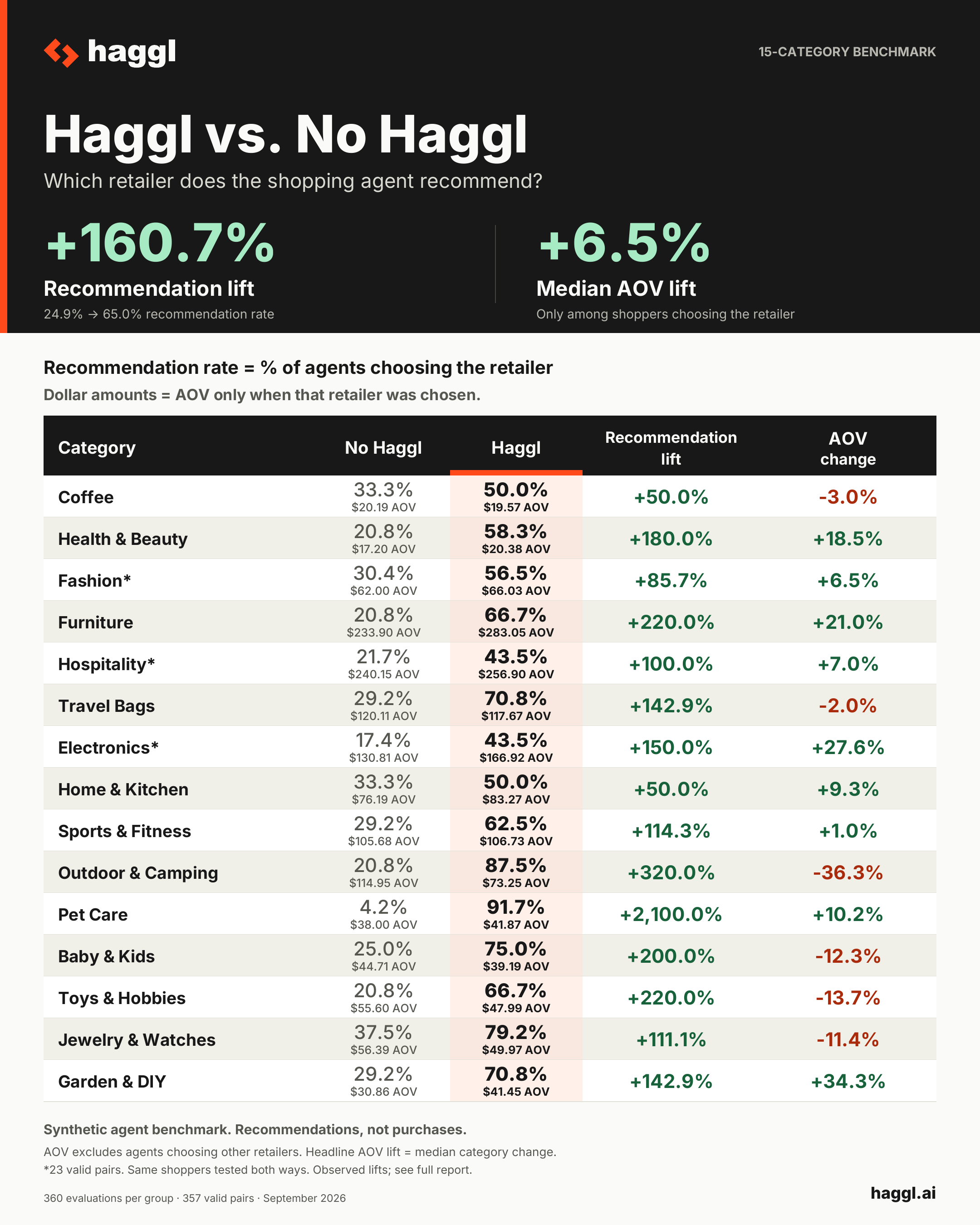
Synthetic agent benchmark
A matched comparison of retail and hospitality shopping tasks with and without haggl.ai.
Each arm shows the share of agents recommending the retailer, with conditional AOV below: the average basket value only among agents choosing that retailer.
| Category | No haggl.ai | haggl.ai | Recommendation lift | AOV change |
|---|---|---|---|---|
| Coffee | 33.3%$20.19 AOV | 50.0%$19.58 AOV | +50.0% | -3.0% |
| Health & Beauty | 20.8%$17.20 AOV | 58.3%$20.38 AOV | +180.0% | +18.5% |
| Fashion* | 30.4%$62.00 AOV | 56.5%$66.03 AOV | +85.7% | +6.5% |
| Furniture | 20.8%$233.90 AOV | 66.7%$283.05 AOV | +220.0% | +21.0% |
| Hospitality* | 21.7%$240.15 AOV | 43.5%$256.90 AOV | +100.0% | +7.0% |
| Travel Bags | 29.2%$120.11 AOV | 70.8%$117.67 AOV | +142.9% | -2.0% |
| Electronics* | 17.4%$130.81 AOV | 43.5%$166.92 AOV | +150.0% | +27.6% |
| Home & Kitchen | 33.3%$76.19 AOV | 50.0%$83.27 AOV | +50.0% | +9.3% |
| Sports & Fitness | 29.2%$105.68 AOV | 62.5%$106.73 AOV | +114.3% | +1.0% |
| Outdoor & Camping | 20.8%$114.95 AOV | 87.5%$73.25 AOV | +320.0% | -36.3% |
| Pet Care | 4.2%$38.00 AOV | 91.7%$41.87 AOV | +2100.0% | +10.2% |
| Baby & Kids | 25.0%$44.71 AOV | 75.0%$39.19 AOV | +200.0% | -12.3% |
| Toys & Hobbies | 20.8%$55.60 AOV | 66.7%$47.99 AOV | +220.0% | -13.7% |
| Jewelry & Watches | 37.5%$56.39 AOV | 79.2%$49.97 AOV | +111.1% | -11.4% |
| Garden & DIY | 29.2%$30.86 AOV | 70.8%$41.45 AOV | +142.9% | +34.3% |
You choose the offers, personas, budget and max discount your sales agent works with. Review the configuration before activating a pilot.
Some supported flows use documentary evidence. Email-signature checks establish signed origin, not every customer claim. We agree the information and consent requirements for your pilot before launch.
The learning pilot will test assumptions against actual purchases and repeat business over a defined observation period. Future value is uncertain.
Our ambition is to learn patterns across similar businesses. We will test whether those patterns improve results for new merchants before claiming a network advantage.
Pay for performance
On Pay as you go, haggl.ai earns a fee only after a negotiated offer leads to a verified paid purchase: 10% of the discount actually used, or 1% of the sale when the offer has no discount (a bundle, a plan or a gift). A $20 concession becomes $18 in shopper savings and a $2 haggl.ai fee.
Start with 50 free negotiations each month. Pay as you go supports 500 total negotiations per month, with no base fee or fee per attempt. You choose when to enable billing.
Fees waived on Free. No automatic upgrades. Refunds adjust the fee.
Discuss a focused pilot: the customers to serve, offers to test and outcomes to measure.
haggl.ai is performance marketing for agentic commerce. Your SaaS business gets a sales agent that talks with buyers’ agents, understands needs such as team size and use case, and makes personalized plan offers within the budget you cap.
Your sales agent uses your business description, personas, budget and max discount to discuss the buyer’s needs. The budget includes the haggl.ai fee.
Connect your Stripe account and map personas to supported prices. An accepted deal creates a dedicated Stripe Checkout Session on your account at the negotiated discount, valid for 24 hours and consumed on payment. You can configure your own checkout URL instead. An accepted offer is not a completed payment.
Compatibility depends on the agent, its tools and how it discovers your business. haggl.ai supports discovery through storefront metadata, browser tools and MCP. We test the actual discovery and negotiation path for your pilot; a platform name alone does not establish compatibility.
An agent appears once haggl.ai is installed on the merchant’s own store or website: the haggl.ai Shopify app on their store, the haggl.ai app for Wix on their site, or the haggl.ai snippet, which we detect automatically on their site. Nobody can list an agent for a store or site they don’t control. Listing is on by default, and you can ask us to turn it off at any time.
The learning pilot is designed around relevant information shared in the agent conversation. Evidence requirements depend on the supported flow and merchant configuration. We agree and test those requirements before launch; no Gmail connection is implied by the pilot invitation.
The standard hosted flow checks email signatures (DKIM) to establish signed origin, not every claim about the customer. Original message fields are removed before pricing-model input and storage; submitted excerpts, profile fields and verification results may remain. Custom integrations need their own data review.
Future customer value is an estimate. Our planned learning pilot will compare starting assumptions with purchases and repeat business over a defined period. We do not treat a persona or a negotiation as proof of lifetime value.
Existing order history can help establish a starting point. We will assess the available data and may use conservative assumptions where history is limited. The pilot scope will specify the supported data connections and what can be measured.
We plan to compare offer strategies and follow purchases, discounts, refunds and repeat business where the necessary data is available. Accepted offers and checkout handoffs are separate from paid purchases. We will agree the observation period and identify missing cost inputs before interpreting results.
Discuss a focused pilot with us. We review your business and available data, configure the supported integration, and agree the budget, max discount and comparison before activation. Current product setup remains available from the site navigation.
haggl.ai uses pay-for-performance pricing. Start with 50 free negotiations per calendar month, with haggl.ai fees waived. Choose Pay as you go for 500 total negotiations per month: haggl.ai earns 10% of the discount actually used, or 1% of the sale when the offer has no discount (a bundle, a plan or a gift), on verified paid purchases only. The 10% sits inside your approved discount budget. No monthly base fee, no fee per attempt, and no automatic upgrade. Current pricing for new signups since September 14, 2026: Free and Pay as you go replace the former Starter, Growth and Pro monthly subscription tiers. Existing legacy agreements remain in effect until explicitly changed. Updated October 6, 2026: Pay as you go also covers offers without a discount (a bundle, a plan or a gift), at 1% of the sale. Pay as you go agreements accepted before then keep their terms until the merchant accepts the update on the plan page.
That is a development goal. We aim to learn which questions and offers help similar businesses, then test whether those patterns improve outcomes for merchants excluded from training. A shared learning advantage has to be demonstrated.