haggl.ai Blog
The Price of Winning You
By Raphael Cohen, founder and CEO of Haggl
When you buy a product, the merchant is also trying to win something: your future business. The price you agree on can reflect the value of both.
That is the idea behind a different view of personalized pricing. You bring more to a transaction than the money you spend today. You bring the possibility of repeat purchases, a lasting relationship and future profit. A merchant that wants that relationship has a reason to invest in it. Some of that investment can come directly back to you through a lower price.
Your future business has value. Your price should reflect it.
Turn the familiar market around
The economics textbook gives us a familiar picture: merchants supply products, consumers demand them, and the price emerges where supply meets demand. It is a useful view of the product market.
Now look at the customer relationship. Consumers supply the opportunity for a relationship. Merchants demand those relationships because of the value they expect them to generate. The merchant becomes a buyer, deciding how much it is willing to invest to win or keep a customer.
The product market continues to exist. Alongside it is a customer market, and the two meet in the same transaction. The consumer decides what the product is worth. The merchant decides what earning that consumer’s business is worth.
A merchant bids for your future business through the price it offers today.
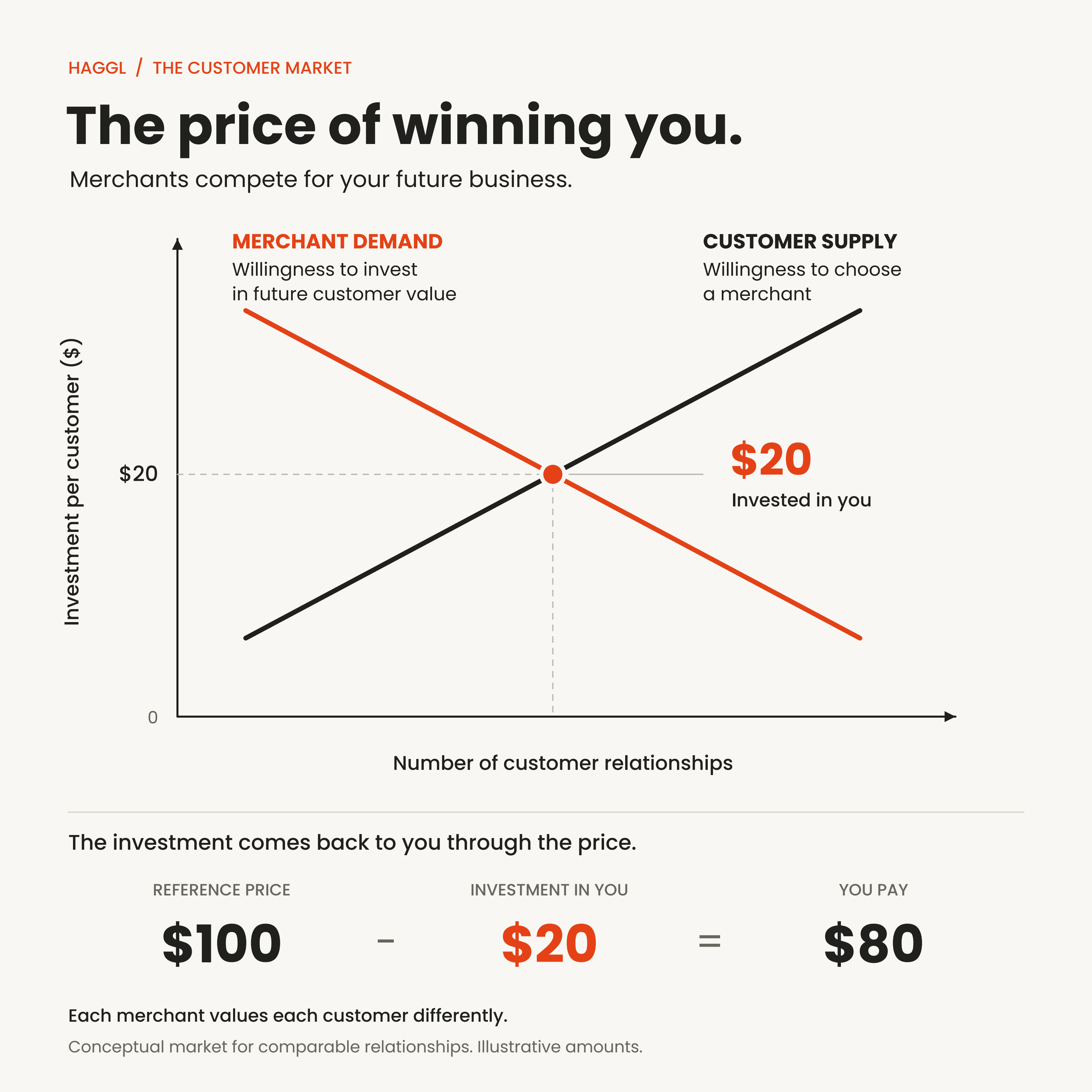
A discount is an investment paid to the customer
Suppose a product normally costs $100. A merchant decides that earning your business justifies giving you $20 of value today. You pay $80.
From the product side, the merchant has discounted the item. From the relationship side, it has invested $20 in acquiring you as a customer. You receive that investment through the price, while the merchant gives up revenue today in expectation of a worthwhile relationship over time.
This is acquisition money. For an existing customer, it can be retention money. In either case, part of the value the merchant expects from the relationship reaches the person creating it.
The $20 in this example is the saving received by the customer. Any fees add to the merchant’s total cost and must be included in its decision. Our separate explanation of Haggl’s fee model covers how an authorized concession is divided in the product.
Paying the gatekeeper and investing in the relationship
Picture a gatekeeper at the entrance to a marketplace. The gatekeeper knows what a shopper is looking for and can guide them to a particular stall. A merchant pays for that introduction because it may lead to a sale.
That is a useful way to think about advertising around purchase intent. The merchant buys access to an opportunity. Even when predicted lifetime value informs the advertising bid, the payment goes to an intermediary for access to the shopper.
The exchange proposed here has a different recipient and purpose. The merchant directs value to the customer through an offer, investing in the future business it wants to earn. The customer can see that investment, compare it with alternatives and choose.
Advertising may still help people discover products. The opportunity is to let customers capture a share of the budget merchants are prepared to spend acquiring or retaining them. The negotiation makes that share part of the transaction itself.
Why the offer should be personal
Imagine two people considering the same running shoes. One buys a pair every few years. The other runs regularly, replaces shoes often and is looking for a store they can return to. They might have the same budget for today’s purchase, while representing different expected relationships for the merchant.
A merchant that can serve the regular runner well may have more room to invest in winning their business. Another merchant may see a different opportunity. Lifetime value is specific to the relationship: the person, the merchant, the products, the service and the terms.
The relevant value is expected future contribution after the costs of serving the customer, with uncertainty and timing taken into account. A large spending history alone does not establish a profitable relationship. Returns, service costs, repeat behavior and the concessions needed to retain the customer all matter.
That leads to a different question for personalized pricing: what is earning this customer’s business worth to this merchant? The customer’s ability or willingness to pay is a separate question. The purpose of this model is to return some of the relationship value through a better offer.
Higher expected value creates room for a larger investment. Competition and the customer’s alternatives influence how much is offered. A merchant also needs to ask whether the offer changes the outcome: a discount to someone who would have bought anyway may simply give away margin.
What data and agents make possible
Businesses have long recognized the value of relationships through introductory offers, loyalty programs and retention deals. The next step is to make that logic more individual, portable and practical at the moment of purchase.
Data can help a merchant estimate the relationship before it has years of experience with that customer. Relevant context might include recurring needs, buying frequency, product fit or a history the customer chooses to share. The estimate should improve as actual purchases, returns and repeat business become visible.
A personal agent can help the consumer bring that context to a negotiation, obtain offers from different merchants and compare the full terms. A merchant agent can evaluate the opportunity and make an offer within the merchant’s economic limits. This is how agentic commerce could make a process once reserved for a sales or retention conversation practical across many everyday purchases.
The idea has roots in Doc Searls’s Intention Economy, in which consumers express what they want and vendors compete to provide it. Tim Berners-Lee describes that vision alongside tools that let people control the data they share. The customer-market framing adds a pricing question: how much of the relationship’s expected value should reach the customer in the offer?
That outcome depends on representation and choice. The consumer’s agent should serve the consumer, and the consumer should control what is disclosed and remain free to walk away. Research on voluntary disclosure and personalized pricing finds that consumer control can improve welfare under conditions that depend on competition and how disclosure works. More data alone does not ensure a better deal.
The merchant, meanwhile, is investing in an expectation. Buying once does not commit someone’s future purchases. The relationship still has to be earned through the experience that follows.
The customer market Haggl is building for
Haggl’s role in this picture is on the merchant’s side: understand the customer opportunity, decide what investment the business can justify, and turn it into an offer the customer’s agent can evaluate.
The direction is to connect conversations and offers to real outcomes, so merchants get better at deciding which relationships to pursue and how much to invest. A convincing conversation is only a starting point. The economic test is whether the offers create worthwhile relationships after their costs.
For the consumer, the promise is concrete: the value of your future business can become a reason for a better price today. For the merchant, the same concession becomes a deliberate acquisition or retention investment.
The next price negotiation can include what both sides are trying to acquire: a product for the customer, and a relationship for the merchant.
Explore Haggl for merchants, or talk to us about the customer-market thesis.